One location. Change the numbers.
What would it take?
Explore the gym’s costs, students and partner shares. Then check the people living within a 10–15 minute drive.
Changes stay in this tab until you copy a plan link. Excel starts with the default numbers, not your slider changes.
01 / Money planner
Keep it simple.
How many paying students?
People, not memberships. A family of four counts as four students and one bill.
The line between these targets is gradual. These are what-if targets, not measured demand. Churn is already reflected in the targets.
What does it cost to open?
Starting allowances, not contractor quotes. Pick an estimate or change any line. Purchase price is not the whole launch cost.
Moves the work and equipment lines together. Tax, overruns, fees and opening cash stay separate. A lower budget does not prove the work can be done for that price.
Edit building and startup costs
Edit monthly bills
Monthly bills exclude loan payments, card fees, student insurance, coach help and owner pay. Those are added below. Custom software development and marketing services cost $0 here. Hosting and printed materials still cost money.
More cost and payment settings
All successful payments use the domestic-card rate. Optional Stripe Billing is off. Student insurance uses the highest enrollment reached so far, with separate policy minimums. Actual quotes may differ.
Down payment and cash left
Starting plan: $30,000 already held by the working owners, not a loan to repay. Sources 1–3 propose another $90,000, $25,000 and $35,000. They start as tentative until commitments and funding are confirmed. Sources 4 and 5 are empty.
The $35,000 is a proposed cash contribution, conditional on obtaining financing. This scenario does not include payments on a separate collateral-backed business loan. If the gym must make those payments, this is not yet a complete cash-flow plan.
The 30-year payment schedule and 8.5% rate are assumptions, not a lender offer. The current example assumes no earlier lump-sum payoff is required. Confirm the actual due date, rate changes, extra-payment rules and any early-payoff charge before signing. Change the mortgage amount above to test a different down payment.
Ownership starts with the previous illustrative 50% investor pool, split by the three proposed cash amounts. These are editable examples, not agreed ownership or promised repayment. The $30,000 working-owner cash has no repayment schedule.
Working-owner pay first
This is the combined take-home target, not per person. Before the full-pay month: $0 in months 1–3, 30% of target in months 4–6, then 60%. Actual pay is limited to money the gym makes after bills, debt and the replacement allowance. Missed pay does not build up as a debt.
02 / Partners
Who puts money in?
Change the cash and the ownership separately. The working owners keep whatever share is left.
Optional shortcut. It divides only the percentage above, not the whole company.
No investor payouts in months 1–24. Any early extra payout goes to the working owners. From month 25 or your later chosen month, available money is split by ownership after the cash cushion and growth savings. There is no automatic catch-up payment.
| Source | Money put in | Owns | Month 60 payout | Cash received in 5 years | When payouts match money put in | Share needed for monthly target |
|---|
Matching the original investment is just a comparison. It does not end ownership, promise a return, repay a loan or buy anyone out. A smaller permanent share still receives a share of future payouts. These scenarios cover this location only, with no sale proceeds or future-location value.
Five years, at a glance
| Year | Students at year end | Money from customers | Bills and debt | Working-owner take-home* | Extra owner payouts* | Investor payouts* | Spendable bank cash at year end |
|---|
*Take-home includes the selected personal-tax allowance. Extra owner and investor payouts are before personal tax. Replacement savings are separate from spendable bank cash. The opening cash cushion is not an expense.
03 / Local people
The people within driving distance.
Custom estimates for people driving to 139 Maxine. The 15-minute area includes the 10-minute area. They are not two separate populations to add together.
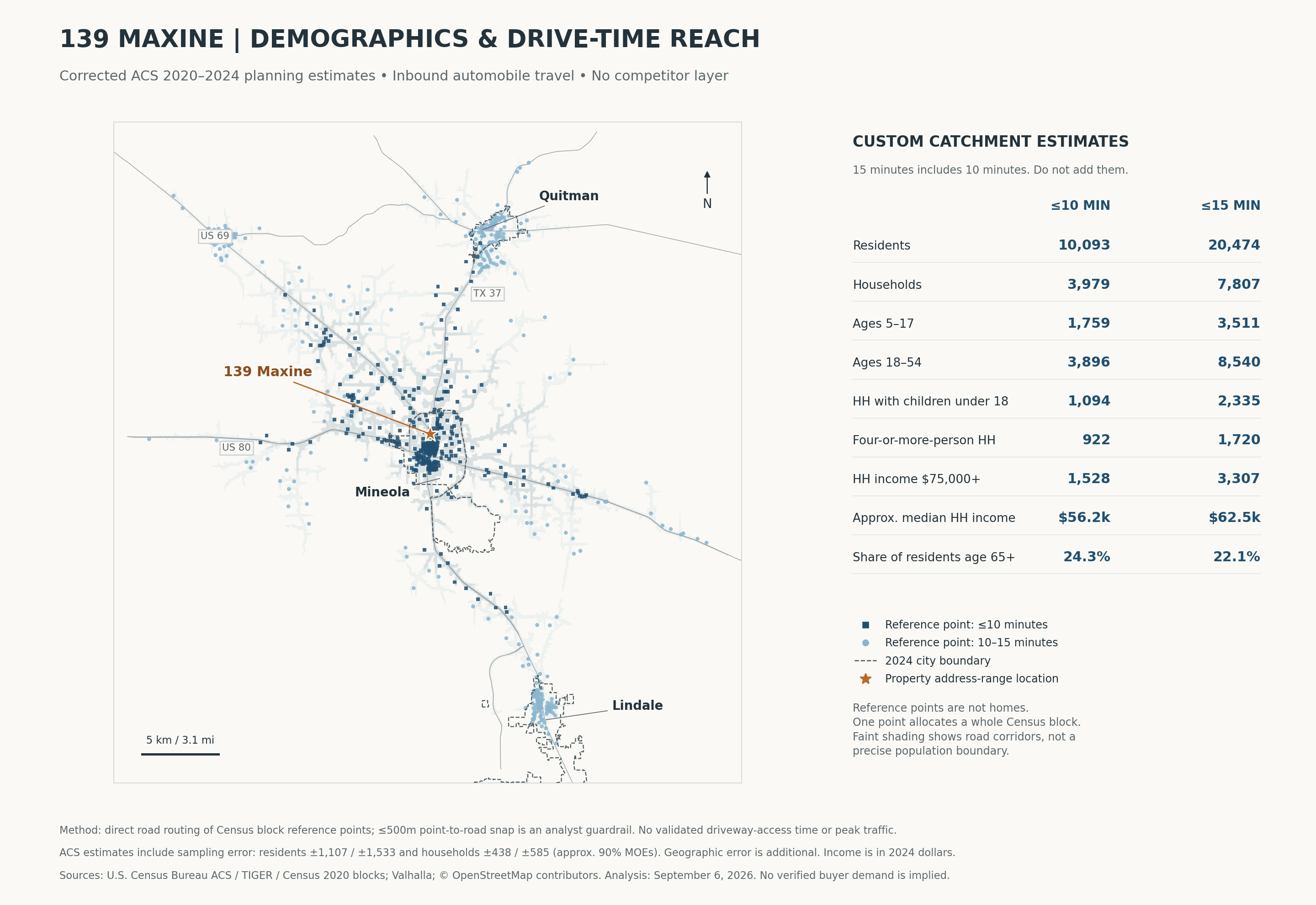
Open the map for full size. Points are Census block reference points, not individual homes. Map: Census geography and OpenStreetMap roads routed with Valhalla.
| Measure | 10 minutes | 15 minutes |
|---|
| Age | 10 min | 15 min |
|---|
| Income | 10 min | 15 min |
|---|
These counts describe the area. They do not show how many people want BJJ, can fit the schedule, or will pay. Income, age and household makeup are separate counts, not a measured list of qualified customers.
04 / Sources & limits
What is known. What still needs checking.
How the drive-time estimates were made
Origin: Census address-range match for 139 MAXINE ST, Mineola, TX 75773, at 32.675936, −95.488240. The entrance is not surveyed. The address is also marketed as Maxine Dr.
Valhalla automobile routing classified 2,201 populated or housing-unit Census block reference points using inbound travel times of 600 or 900 seconds. Fifty complete candidate block groups and 2,929 block records were checked. A reference point was included only if its road snap was within 500 meters, an analyst assumption. No route failures occurred.
2020 block population weights allocate ACS person counts. 2020 housing-unit weights, including vacant units, allocate household counts within 2024 block groups. This cannot observe every household’s location, within-block-group differences or new development. Default road speeds are not live traffic. Driveway access, parking and queues are not validated.
± figures are approximate 90% sampling margins. They exclude routing and geographic uncertainty. Median income is interpolated from pooled income bands in 2024 dollars and has no calculated margin of error. These are custom estimates, not Census-published drive-time statistics or a current headcount.
Census block-group boundaries · 2020 Census blocks · Valhalla route matrix · OpenStreetMap attribution
Cost sources and money-planner assumptions
Budget prepared September 6, 2026. Purchase starts at $180,000 as a negotiating assumption. Startup estimates include interior changes and a 1,500 sq ft mat system, fees, pre-opening bills, tax and a work-overrun allowance. Opening cash adds the worst cumulative cash loss in the first selected months plus the minimum cushion. It does not add five years of bills to the building price.
This simplified planner differs from the detailed model: four editable student milestones replace its enrollment funnel, prices stay flat, and costs start with a 3% annual increase. Source 2 starts as tentative. No loan is approved in this tool. Collateral is information only and contributes $0 of spendable money. Operating results assume any opening gap is covered without extra debt payments or giving away additional ownership. Enter the actual financing terms before relying on payouts.
The tax setting starts at instruction-only membership treatment. Change the taxable share to test tax absorbed inside advertised prices. Ask a Texas CPA to determine the actual treatment. Full tax accounting, depreciation, sale proceeds and new locations are outside this calculator. Startup tax and dues-tax settings are separate.
Construction, insurance, use approval, coach coverage, building condition and exact lending terms need quotes or professional review. Keeping money for growth reduces payouts but does not assume that new locations have been funded or built.
Stripe US card pricing · Optional Stripe Billing pricing · Texas remodeling sales tax
Ownership and tax notes
Ownership percentages here are negotiating examples, not signed terms or a business valuation. A Texas attorney and CPA should define voting rights, payout rules, future funding, which entity owns the building, transfers and any agreed buyout. This page does not choose the LLC’s tax treatment or create an investment agreement.
An LLC with multiple members is commonly taxed as a partnership unless it elects another treatment. Partners can owe tax on allocated income even when cash stays in the business. A no-payout period therefore needs a specific tax-payment policy in the agreement. This tool does not model tax distributions to investors. IRS LLC tax treatment · IRS partnership guidance.